

There’s clever marketing… and then there’s “what were they thinking?”
Brisbane, Australia – May 21, 2025 — Recently, Australian oral care brand White Glo launched a campaign across Melbourne trams with the slogan:
“Melburnians, make the White Choice today!”
As a marketer, I get the intention. It’s a pun. It plays off the brand name. It ties into the product benefit: whiter teeth. But as someone who works in branding, communication and community, intention doesn’t erase impact. This campaign is a textbook example of how playful wordplay can veer straight into problematic territory.
Let’s talk about the phrase
“Make the White Choice” isn’t just a throwaway pun. It’s language steeped in historical weight. This phrase, or ones dangerously close to it, have long been used in white supremacist and segregationist rhetoric.

So when a brand with “White” in its name uses that phrasing publicly, on mass transit, in one of Australia’s most multicultural cities, it’s more than tone-deaf. It’s harmful.
But it was approved by the regulator?
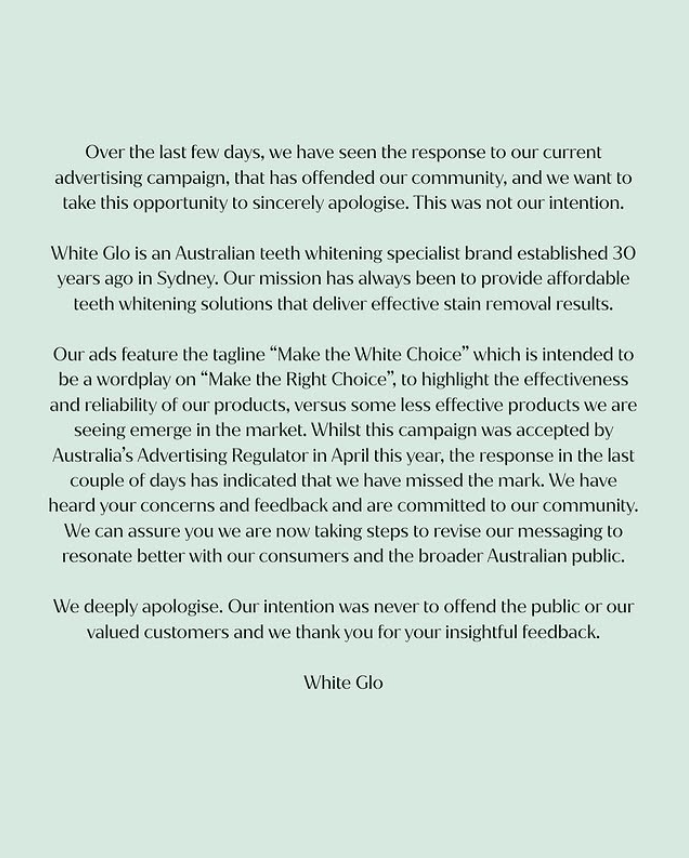
After initially doubling down, White Glo released a wall-of-text-on-a-static-background™️ post apology and defended the slogan by saying it was approved by Australia’s advertising regulator.
Sure. But regulators often assess campaigns for legality, not morality. “Technically allowed” doesn’t mean “culturally responsible”. If anything, it highlights how our systems lack the nuance to identify implicit racial harm, especially in marketing.
It’s time for regulators to evolve with the times or risk becoming complicit in these missteps.
Marketing isn’t just about wordplay. It’s about context
I work in video games, and when we say “gaming” in Australia, we constantly have to clarify that we mean interactive entertainment, not gambling. Why? Because in a specific cultural context, a word can mean something entirely different. That’s Branding 101.
So how did White Glo, a brand literally built around the word “white”, not have any internal red flags about this phrase? Where were the tone of voice guidelines? The cultural sensitivity checks? The diverse reviewers?
These processes exist for a reason. To prevent moments like this.
What they should have done
Instead of doubling down with a half-hearted “sorry if you were offended” statement, White Glo could have done so much better:
- Acknowledged the oversight: Not “we didn’t mean it like that”, but “we see how this language is harmful and we’re taking it down immediately”.
- Removed the campaign: The longer it stays up, the more dismissive the brand appears of real, valid concerns.
- Updated internal processes: Include diverse voices. Run campaigns through cultural filters. Don’t rely solely on puns when your brand name walks a fine linguistic line.
We can and must do better
Marketing is powerful. It can uplift, entertain and educate. Or it can reinforce bias, cause harm and exclude. And in a politically charged time like this, where conversations around race, nationalism and identity are more sensitive than ever, brands need to step up.
And in an election year too? C’mon!
Written by Cassie McDonnell.
 Cassie McD